
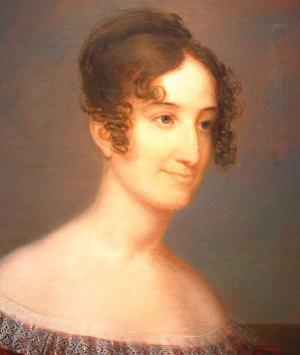
Ann Croghan was born in October of 1797 at Locust Grove, the eldest daughter of William and Lucy Croghan. She and her younger sister, Eliza, were both well-educated in a time when women’s education was primarily confined to their homes. Ann and Eliza briefly attended the Ladies’ Domestic Academy in Springfield, KY, in 1809, but soon returned home as their mother, Lucy, described herself as “pining” for her daughters. Upon their return, Lucy and their aunt Emilia Clarke oversaw their education.
By 1819, gentlemen across the country were striving for Ann’s hand in marriage. However, in the spring of 1822, Ann (22) married General Thomas Sidney Jesup (33). The couple established their home in Washington, D.C., where Ann became known for her social graces and assisting her husband in his engagement in the political landscape.
While Jesup served as Quartermaster General of the United States Army, letters indicate that Ann ran their household, took great care of their children, and maintained the ties between her family at Locust Grove.
Because of her separation from her Kentucky home, she wrote many letters to her family, especially her mother, Lucy. Ann’s letters display great affection and personality, often feeling more conversational than informational.
Recently, a receipt book of Ann’s was found in The People’s Archive in Washington, D.C., giving us more insight into her daily life. The book reflects a family first establishing their home in the summer of 1823, purchasing items such as tea caddies, candlesticks, coffee mills, and medicine. Ann also purchased a “breast pipe,” which is an early rendition of the breast pump, as well as rattle weed root and castor oil to relieve the pain of childbirth.
Perhaps the most fascinating part of this receipt book reveals Ann’s literary choices and her potential ideologies. Receipts from October 1824 show Ann purchased titles such as Hobomok and Redwood. These literary works, both written by female authors and featuring strong-willed female protagonists, critique the strict societal boundaries that women like Ann faced in the early 19th century. While we don’t know if she embraced every view in these texts, we can infer that she held progressive ideas while navigating the societal roles of an early American upbringing. These texts certainly served as a stimulus to stretch Ann’s way of thinking while the world was rapidly evolving around her.
Ann fell ill in 1842 and underwent a long, difficult recovery. Her death in 1846 was shocking to her family; her husband was distraught and spared no expense for her funeral and the burial. The costs totaled $120.37, which is equivalent to about $5,000 today.
Ann’s legacy is that of a strong, intelligent, and progressive woman. She experienced both the frontier life of Kentucky and the political landscape of Washington, D.C., constantly challenging the intellectual limits placed on women of her time. Her receipt book provides a brief glimpse of successes as a wife and mother without losing her curiosity or progressive mind for the entirety of her life.