
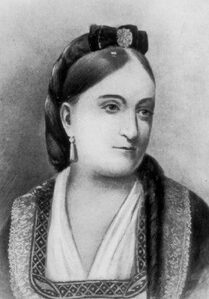
Mary Croghan Schenley was born at Locust Grove on April 27, 1827 to William Croghan Jr. and Mary O’Hara Croghan. Sadly, Mary’s mother passed away soon after her birth, followed by her 4-year-old brother the next year. In November of 1827, William Croghan Jr. moved to his wife’s hometown of Pittsburgh, where his daughter could be closer to her mother’s family.
When Mary was fifteen, she attended boarding school in Staten Island, New York. It was there that she met and fell in love with 43-year-old Captain Edward William Schenley. In 1842, they eloped to England. This was the captain’s third elopement, and the controversy was covered in American newspapers as the “Greatest Romance in History.”
The scandal was immense. It was reported that upon hearing the news, Mary’s father fainted. He demanded that the federal government intercept the ship to England and ordered church ministers and newspaper editors not to cover the story. Even Queen Victoria refused to present the couple at court for many years because of the scandal.
Mary’s father disapproved so strongly that he hardly communicated with her for seven months, despite Mary begging him to visit and apologizing in her letters. Eventually, William reconsidered and traveled to the Schenleys’ home in England, and worked to repair their relationship.
Mary had 11 children in her lifetime. By the time of her death on November 5, 1903, in London, she was the largest owner of real estate in Alleghany County, Pennsylvania.
Mary Croghan Schenley was described as a “hard-headed”, strong, and intelligent philanthropist. In the late 19th century, she donated large sums to many churches and public schools. She also donated land to the city of Pittsburgh in 1889 for “Schenley Park”, gave the Fort Pitt Blockhouse to the Daughters of the American Revolution, and donated 19,000 acres of land to the Carnegie Institute.
Her name is immortalized across Pittsburgh, with many places such as Schenley High School, Schenley Hotel, Schenley Bridge, Schenley Park, Schenley Plaza, Schenley Quadrangle, Schenley Tunnel, and the Mary Schenley Memorial Fountain honoring her. These monuments ensure that Mary is remembered for her immense generosity.